
Morpho: A Protocol Autopsy
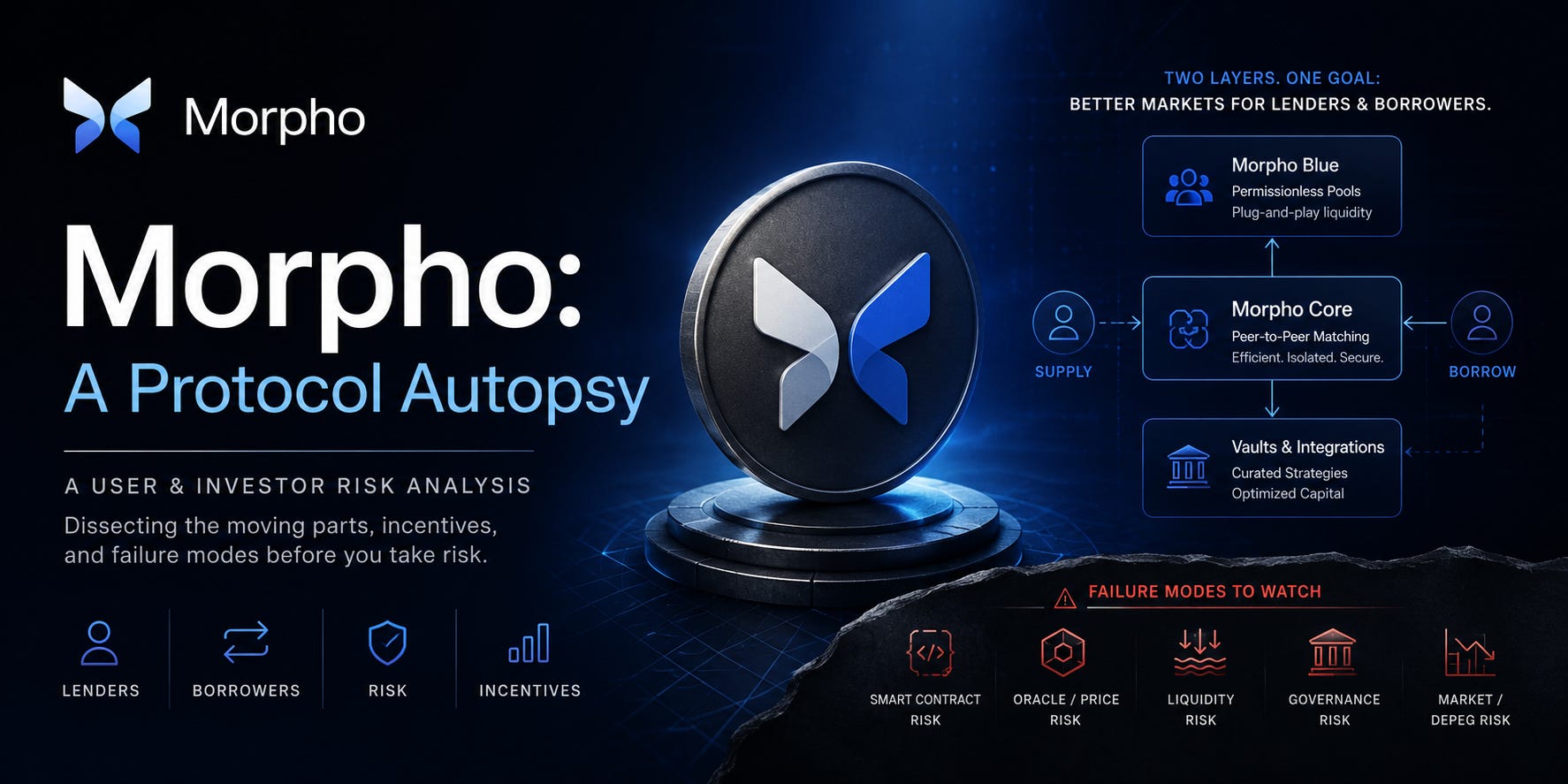
This protocol autopsy looks at Morpho from a user and investor risk angle.

Date: 2026-07-15
Protocol: Morpho
Repository / contracts: https://github.com/morpho-org/morpho-blue (core), https://github.com/morpho-org/metamorpho (vaults)
Chains: Ethereum, Base, 30+ EVM chains
Scope: Investor-facing protocol and contract snapshot, not a full security audit
Disclaimer: This report is provided for informational purposes only and does not constitute financial, legal, or investment advice. It is not a comprehensive security audit; it offers a high-level, observation-based overview of the protocol’s design, fund flows, and business mechanics derived from available documentation and on-chain code. Findings may be incomplete and should not be relied upon for security or investment decisions. Conduct your own research and engage qualified professionals before acting.
VERDICT: MODERATE RISK
Bottom line: Morpho has a comparatively strong immutable core, but users still face market, oracle, curator, and isolated bad-debt risk.
Best suited for: active DeFi users who understand lending-market and curator risk
Main appeal: minimal immutable lending infrastructure with real borrower-paid yield
Main danger: bad debt or oracle failure in an isolated market
Why it lands here: immutable core lowers admin risk, while vault curator and market risk remain material
Before using it: Verify the specific market, oracle, LLTV, curator, and vault allocation before depositing.
Rating guide: Low risk means comparatively simple and verifiable, not safe. Moderate means understandable but with meaningful risks. High means material fund-risk dependencies. Extreme means avoid unless advanced and sized for full loss. Not rateable means source quality is too weak.
This protocol autopsy looks at Morpho Protocol from a user and investor risk angle. It is meant to make the main moving parts, incentives, and failure modes easier to read before someone bridges, deposits, stakes, borrows, or buys exposure.
The Decision In One Minute
The Trade-Off
Immutable core lowers admin risk, while vault curator and market risk remain material. The core trade-off is minimal immutable lending infrastructure with real borrower-paid yield in exchange for accepting bad debt or oracle failure in an isolated market.
What Could Still Surprise You
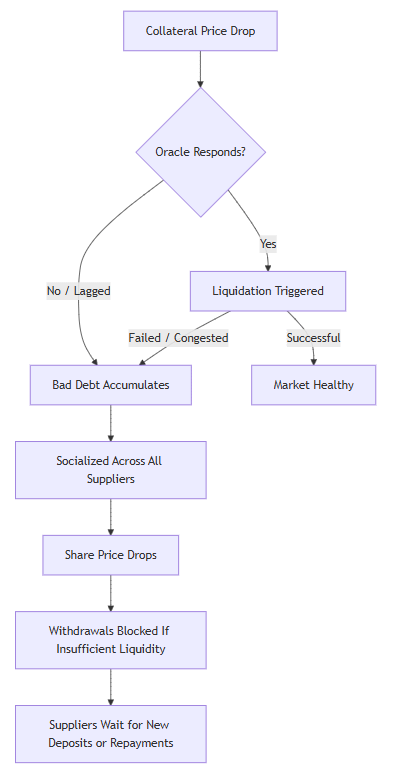
Bad debt socialization in an isolated Blue market. If collateral value drops below borrow value and liquidation fails, remaining suppliers in that market absorb 100% loss of the shortfall. Vault depositors are protected by curator allocation discipline but can still lose principal if a vault concentrates in a failing market.
Users still need to verify the exact contract set, market, vault, or bridge they are touching rather than relying on the protocol brand alone.
The rest of this report traces the money path, the failure paths, and the controls that can change the outcome.
What It Does And Why Users Use It
Protocol promise: Morpho is a modular, noncustodial lending protocol split into two layers: Morpho Blue (immutable, isolated lending markets) and Morpho Vaults (curator-managed allocation strategies). It is the 3rd largest lending protocol by TVL and a direct competitor to Aave and Compound.
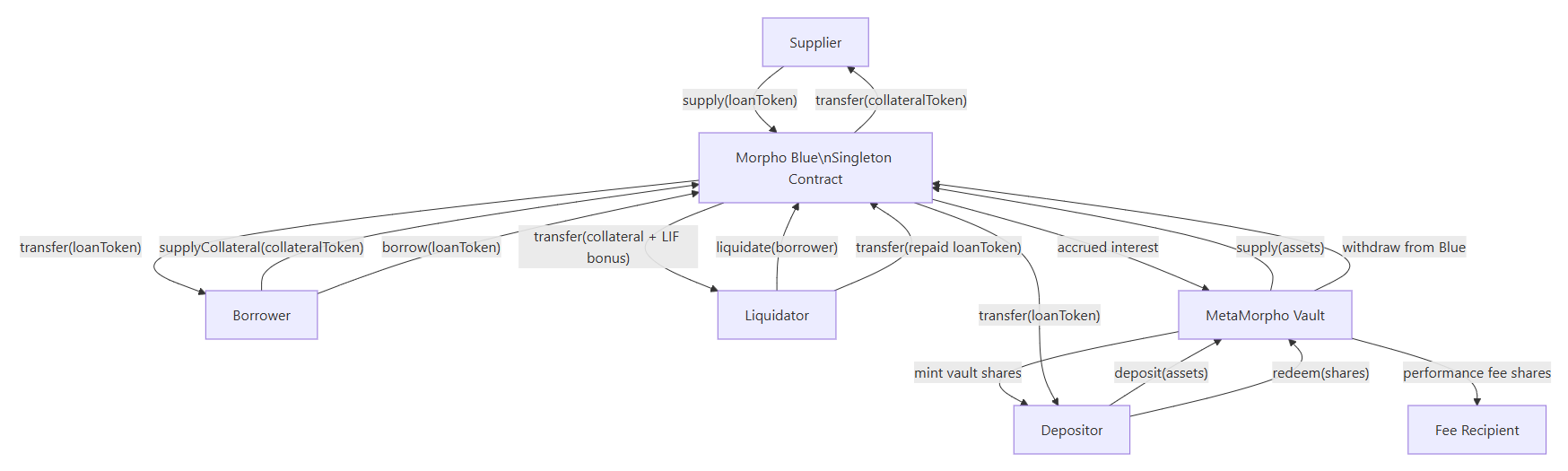
Actual mechanism: Users deposit loan tokens into isolated Blue markets (or into Vaults that allocate across markets). Borrowers post collateral and borrow against it. Interest accrues via an adaptive IRM. Liquidations are permissionless.
Reward source: Suppliers earn borrow APY scaled by utilization, minus protocol fee (max 25%). Vaults add a performance fee (max 50% of yield) and management fee (max 5% annualized). Yield is real (interest from borrowers), not inflationary.
Key dependency: Conditionally sustainable. Revenue comes from borrow interest (real yield). $175M raised in 2026 provides long runway. Token emissions are governance-controlled and currently inflationary. Long-term sustainability depends on V2 adoption and institutional revenue.
Participation window noted in source report: Mature phase for Blue and Vault V1/V1.1. V2 (in development) promises market-determined pricing and cross-chain loans. Current sweet spot: depositors seeking 4-8% USDC yields via curated vaults with known curators.
How Money Moves
Primary Paths
Supply (Blue market)
In:
supply(MarketParams, assets, shares, onBehalf, data)- caller deposits loan tokensHeld as: Supply shares (proportional claim on total supply assets + accrued interest)
Out:
withdraw(MarketParams, assets, shares, onBehalf, receiver)- burns shares, transfers loan tokens. Reverts if insufficient liquidity (totalBorrowAssets <= totalSupplyAssetscheck at line 223).Fees / routing: Protocol fee (0-25%) minted as additional shares to feeRecipient. No transfer fees.
Borrow (Blue market)
In:
borrow(MarketParams, assets, shares, onBehalf, receiver)- requires prior collateral depositHeld as: Borrow shares (debt position)
Out:
repay(MarketParams, assets, shares, onBehalf, data)- repays debt, burns borrow sharesFees / routing: Interest accrues continuously via IRM. Borrower must maintain health factor (collateral price LLTV >= borrow value).
Supply Collateral (Blue market)
In:
supplyCollateral(MarketParams, assets, onBehalf, data)- deposits collateral tokensHeld as: Raw collateral balance (not shares)
Out:
withdrawCollateral(MarketParams, assets, onBehalf, receiver)- reverts if position would become unhealthy.
Liquidation (Blue market)
In:
liquidate(MarketParams, borrower, seizedAssets, repaidShares, data)- permissionless, anyone can callTrigger: Position unhealthy (borrow value > collateral value * LLTV)
Mechanism: Liquidator repays borrow shares, seizes collateral at discount. Liquidation Incentive Factor (LIF) = min(1.15, 1/(0.3*(1-LLTV)+0.7)). Full LIF goes to liquidator.
Bad debt: If collateral fully depleted, remaining borrow is socialized:
totalSupplyAssetsandtotalBorrowAssetsreduced equally (lines 391-402, Morpho.sol).
Vault Deposit (MetaMorpho)
In:
deposit(assets, receiver)ormint(shares, receiver)- ERC4626 standardHeld as: Vault shares (ERC20, representing proportional claim on vault’s total assets)
Out:
withdraw(assets, receiver, owner)orredeem(shares, receiver, owner)- vault withdraws from Blue markets in withdrawQueue orderFees / routing: Performance fee (max 50%) accrued as additional shares to feeRecipient. Management fee (max 5% annualized) in Vault V2 only.
Flash Loans
In:
flashLoan(token, assets, data)- zero fee, access to entire contract balanceOut: Repaid in same transaction via
onMorphoFlashLoancallback
Forensic:
Redeemable: Supply shares are redeemable for loan tokens, subject to liquidity availability (total supply >= total borrow). If a market has bad debt, redeemability is impaired until new supply covers the gap.
Locked: No time locks on withdrawals. However, if all liquidity is borrowed, withdrawals are blocked until borrowers repay or new suppliers deposit.
Routed externally: Collateral tokens are held in the Morpho contract but not lent out (unlike Aave where collateral earns yield). Flash loans draw from the entire contract balance across all markets.
Non-recoverable cases: Bad debt (collateral = 0, borrow > 0) is socialized by reducing totalSupplyAssets. Suppliers in that market absorb the loss proportionally. If feeRecipient is set to zero address, fees are lost (line 99, IMorpho.sol).
What Can Go Wrong
Primary Failure Paths
Bad debt socialization in an isolated Blue market. If collateral price drops faster than liquidators can respond (e.g., oracle lag, market congestion, or depeg), and a borrower’s collateral is fully depleted, the remaining borrow is socialized across all suppliers in that market. If tomorrow: a typical supplier in the affected market loses a proportional share of the bad debt, up to 100% of principal in extreme cases.
Oracle manipulation or failure. If the oracle for a collateral asset returns an incorrect price (due to manipulation, stale data, or feed failure), borrowers may be under-collateralized without triggering liquidation, or healthy positions may be wrongly liquidated. If tomorrow: suppliers in markets with compromised oracles face unexpected bad debt or unfair collateral seizure.
Vault curator misallocation. A vault curator could concentrate deposits in a single high-risk market or a market with a compromised oracle. If that market accrues bad debt, vault depositors absorb the loss through share price decline. If tomorrow: vault depositors in a poorly-curated vault lose principal proportional to the bad debt in the concentrated market.
Failure Scenarios
Bad debt socialization (Blue market)
If it happens: Suppliers in the affected market lose principal proportional to the bad debt. Share price drops. Withdrawals may be blocked until new supply covers the gap.
Trigger: Collateral price drops below borrow value, liquidation is delayed or fails (oracle lag, MEV congestion, gas spike).
On-chain:
liquidatefunction (line 347, Morpho.sol) detectscollateral == 0, writes off bad debt by reducingtotalSupplyAssetsandtotalBorrowAssetsequally (lines 391-402).Bound: Lost (proportional share of bad debt, up to 100% of principal in the market).
Oracle price manipulation
If it happens: Under-collateralized positions go unliquidated, accumulating bad debt. Or healthy positions are unfairly liquidated.
Trigger: Oracle feed manipulation (e.g., Chainlink feed stale, spot price manipulation for low-liquidity pairs), or oracle returning extreme values.
On-chain:
_isHealthy(line 514, Morpho.sol) usesIOracle(marketParams.oracle).price()for health checks.liquidate(line 361) uses oracle price for LIF calculation.Bound: Lost (bad debt from under-collateralized borrows) or seized (unfair liquidation of healthy positions).
Vault curator concentration risk
If it happens: Vault depositors lose principal if the curator allocates heavily to a market that accrues bad debt.
Trigger: Curator reallocates vault funds to a single risky market (e.g., new collateral with unproven oracle). Market fails.
On-chain:
reallocate(line 366, MetaMorpho.sol) allows allocators to move funds between markets. No per-market concentration limit enforced by the protocol.Bound: Lost (proportional to bad debt in the concentrated market).
Bank run / liquidity crunch
If it happens: Withdrawals are blocked because
totalBorrowAssets > totalSupplyAssets. Suppliers must wait for borrowers to repay or new suppliers to deposit.Trigger: Mass withdrawal request, borrower defaults, or market panic.
On-chain:
withdraw(line 200, Morpho.sol) reverts withINSUFFICIENT_LIQUIDITYiftotalBorrowAssets > totalSupplyAssets(line 223).Bound: Locked (funds are not lost but inaccessible until liquidity is restored).
Governance fee shock
If it happens: Owner sets fee to 25% on a popular market, reducing supplier APY.
Trigger: Owner decides to maximize protocol revenue, or owner key is compromised.
On-chain:
setFee(line 123, Morpho.sol) allows owner to set any fee up toMAX_FEE(25%).Bound: Diluted (supplier yield reduced by up to 25% of interest earned).
IRM malfunction
If it happens: Borrow rate calculation returns extreme values, causing excessive interest accrual or zero rates.
Trigger: AdaptiveCurveIRM edge case, unexpected utilization pattern, or IRM contract bug.
On-chain:
_accrueInterest(line 482, Morpho.sol) callsIIrm(marketParams.irm).borrowRate(marketParams, market[id])and applieswTaylorCompoundedfor continuous compounding.Bound: Lost (excessive interest accrual could lead to bad debt) or opportunity cost (zero rates reduce supplier yield).
Maximum Loss By Role
Depositor / lender (Blue market): Up to 100% of principal in a single market via bad debt socialization. Funds are locked (not lost) during liquidity crunches.
Depositor / lender (Vault): Up to 100% of principal if vault concentrates in a failing market. Diversification across multiple vaults mitigates this.
Borrower: Collateral seized + liquidation incentive (up to 115% of borrow value via LIF). No additional penalty beyond collateral loss.
MORPHO token holder: No direct cash flow rights. Value depends on governance participation and token appreciation. Subject to dilution from vesting unlocks and governance grants.
Who Can Change The Rules
Source Status
Official deployed source: Reviewed from official repository or verified source as described in the source report
Official repository: https://github.com/morpho-org/morpho-blue (core), https://github.com/morpho-org/metamorpho (vaults)
Review depth: Snapshot review of fund flows and privileged controls only. This rewrite preserves the prior report evidence and does not add a new full audit pass.
Contract Map, Grouped
Morpho Blue (Core Lending Primitive)
Contracts:
Morpho.sol(555 lines, singleton),AdaptiveCurveIRM.sol(interest rate model)Role: Single contract managing all isolated lending markets. Handles supply, withdraw, borrow, repay, liquidate, flashLoan. Immutable and non-upgradable.
Upgrades / proxies: None. Fully immutable after deployment.
Libraries (Morpho Blue)
Contracts:
MathLib.sol,SharesMathLib.sol,ConstantsLib.sol,ErrorsLib.sol,EventsLib.sol,MarketParamsLib.sol,SafeTransferLib.sol,UtilsLib.solRole: Fixed-point math, share/asset conversion with virtual offset (inflation attack protection), error handling, event emission.
Interfaces (Morpho Blue)
Contracts:
IMorpho.sol,IMorphoCallbacks.sol,IIrm.sol,IOracle.sol,IERC20.solRole: Define external integrations: IRM (interest rate model), Oracle (price feed), ERC20 tokens, callbacks for supply/repay/liquidate/flashLoan.
MetaMorpho Vaults (Curator Layer)
Contracts:
MetaMorpho.sol(905 lines, ERC4626 vault),MetaMorphoFactory.solRole: ERC4626-compliant vault that allocates deposits across multiple Blue markets. Managed by Owner/Curator/Allocator/Guardian roles with timelock-gated changes.
Upgrades / proxies: Each vault is deployed as a standalone instance via factory. Not upgradeable.
Libraries (MetaMorpho)
Contracts:
ConstantsLib.sol(MAX_TIMELOCK=2 weeks, MIN_TIMELOCK=1 day, MAX_QUEUE_LENGTH=30, MAX_FEE=50%),PendingLib.sol,ErrorsLib.sol,EventsLib.solRole: Timelock management, pending value handling, fee constants.
External Dependencies
Morpho Blue: Depends on external IRM (AdaptiveCurveIRM) and Oracle (Chainlink or any IOracle implementation). Token must be ERC-20 compliant (no fee-on-transfer, no rebasing).
MetaMorpho: Depends on Morpho Blue singleton (immutable reference set at construction). Uses OpenZeppelin ERC4626, ERC20Permit, Ownable2Step, Multicall.
Admin And Rug Controls
Owner / roles: Present, mitigated. Morpho Blue has a single owner (set at construction, line 75 Morpho.sol) with limited powers: set fee, set feeRecipient, enable IRMs, enable LLTVs. Cannot alter deployed markets, cannot freeze funds, cannot upgrade. Vaults have Owner/Curator/Allocator/Guardian with separated powers and timelock. Code:
onlyOwnermodifier (line 87, Morpho.sol),onlyCuratorRole(line 139, MetaMorpho.sol).Upgrades: None observed for Morpho Blue. Fully immutable. Vault instances are deployed via factory and are not upgradeable. Code: No proxy pattern, no
upgradeTofunction.Liquidity drain: Present, material risk. The owner can set feeRecipient to zero address (line 99, IMorpho.sol: “fees will accrue there and be lost”). The owner can also set fees up to 25% on any market. While not a direct drain, high fees reduce supplier yields. Code:
setFee(line 123, Morpho.sol),setFeeRecipient(line 139, Morpho.sol).Mint/freeze: None observed. No mint function for loan/collateral tokens. No freeze or blacklist functionality in core contracts.
Pause (especially withdraw): None observed. No pause mechanism in Morpho Blue. Vaults have no guardian pause on withdrawals (guardian can only revoke pending timelock actions).
Fee-oracle params: Present, mitigated. Owner can change fees on existing markets (line 123, Morpho.sol). However, IRM and LLTV are set at market creation and cannot be changed. Oracle is set at market creation and cannot be changed. Fee changes accrue interest first, preventing retroactive fee capture. Code:
setFee(line 123, Morpho.sol).Emergency rescue: Present, mitigated. MetaMorpho has
skimfunction (line 478, MetaMorpho.sol) allowing anyone to send excess token balances to skimRecipient. Guardian can revoke pending timelock actions. No emergency withdrawal mechanism for user funds.
Control snapshot: Snapshot only, not a technical audit.
Earnings And Sustainability
Revenue sources:
Protocol fees on borrow interest: 0-25% of accrued interest in each Blue market, directed to feeRecipient (set by owner). Fee is minted as supply shares, so feeRecipient accrues yield. Source:
_accrueInterestin Morpho.sol (lines 482-508).Vault performance fees: 0-50% of interest earned by the vault, accrued as additional vault shares to feeRecipient. Source:
_accrueFeein MetaMorpho.sol (lines 881-888).Vault management fees (V2 only): 0-5% annualized on totalAssets, accrued as shares.
No token emissions as protocol revenue: MORPHO token distributions are governance-controlled grants, not protocol revenue.
Real vs inflationary:
Real yield: All supplier yield comes from borrower interest payments. No inflationary token rewards are baked into the core protocol.
Inflationary component: MORPHO token has 1B max supply, ~11.2% initial circulating supply at transferability (Nov 2024). Strategic partners (27.5%), founders (15.2%), and contributors have vesting schedules through 2028. Governance distributes tokens via grants and rewards, creating ongoing inflation pressure.
Dependencies:
Oracles: Protocol is oracle-agnostic. Reference implementation uses Chainlink (MorphoChainlinkOracleV2). Price returned scaled by 1e36. Oracle failure or manipulation directly affects liquidation accuracy and health checks.
IRM: AdaptiveCurveIRM is the only governance-approved model. Target utilization 90%. Curve shifts adaptively based on sustained utilization. IRM failure could lead to incorrect rate calculations.
Token assumptions: Loan and collateral tokens must be ERC-20 compliant, no fee-on-transfer, no rebasing, no burn functions, no re-entrancy on transfer. Violations could break accounting.
External vault curators: Vault depositors depend on curator judgment for market selection and allocation. Curator error can lead to concentrated bad debt exposure.
SUSTAINABILITY VERDICT: Conditionally sustainable.
Reasoning: Morpho generates real revenue from borrow interest (no inflationary token rewards in core protocol). The $175M funding round provides multi-year runway regardless of revenue. The protocol’s minimal design reduces operational costs. Key dependencies: (1) continued borrowing demand to generate yield, (2) curator quality to maintain vault depositor confidence, (3) V2 delivery to maintain competitive edge, and (4) MORPHO token inflation management. The protocol is not yet self-sustaining on fees alone at current scale, but the funding runway and growth trajectory ($5B to $13B TVL in 2025) suggest a viable path.
Investor Fit
May fit: active lenders who can monitor market parameters and curator choices.
Should avoid: users who need pooled diversification or zero oracle exposure.
Position sizing mindset: Treat this as a protocol-specific risk exposure. Size for the worst-case fund impact described above, not for quoted yield or points upside.
What to monitor: the specific market, oracle, LLTV, curator, and vault allocation before depositing.
When To Participate
Bootstrap (2022-2023): Early suppliers earned high yields from Morpho Optimizer (P2P matching on Aave/Compound). High risk, high reward.
Mature (2024-2026): Morpho Blue and Vaults are production-proven. Yields are moderate (4-8% USDC). Risk is well-understood. Best window for risk-averse depositors.
V2 launch (2026+): New opportunity for early participants in market-determined pricing. Higher complexity, higher potential returns.
Endgame: If Morpho becomes embedded infrastructure (as envisioned), yields may compress toward traditional finance levels. Early adopters benefit from network effects.
Sweet spot: Current phase (mature) is optimal for depositors who understand curator risk. Choose established curators (Steakhouse, Gauntlet) for conservative exposure. Monitor V2 development for next opportunity.
How To Participate
Conventional: Deposit USDC into a curated Morpho Vault (e.g., Steakhouse USDC vault) for 4-8% APY. Monitor curator performance and market allocation. Diversify across multiple vaults to mitigate curator concentration risk. For borrowers: supply collateral (e.g., wstETH, WBTC) and borrow stablecoins against it. Monitor health factor to avoid liquidation.
Unconventional: Provide liquidity directly in Blue markets with higher LLTV (e.g., 94.5% for stable pairs) for higher yields. Extra risk: bad debt exposure in isolated markets. Or: run as a vault curator, earning performance fees on managed allocations. Extra risk: reputational and financial risk if vault underperforms or incurs bad debt.
Comparable Protocols
Judgment: Morpho occupies a unique position as the most architecturally minimal lending protocol with a two-layer design. It competes with Aave and Compound on yield, with Euler V2 and Silo on modularity.
Aave V3/V4
Similarity: Largest DeFi lending protocol. Multi-asset pools, variable and stable rates, flash loans.
Difference: Monolithic pool architecture. Governance controls all parameters. Risk is shared across all assets in a pool. Aave V4 introduces isolation and efficiency modes but remains governance-managed. Morpho’s markets are fully immutable and isolated by default.
Prefer Aave when: You want deep liquidity, governance-managed risk, and don’t need curator-specific strategies.
Compound V3
Similarity: Isolated lending markets (V3), single collateral per market, permissionless market creation.
Difference: Compound V3 markets are simpler but less flexible. No curator layer. Governance still controls risk parameters. Morpho has a richer curator ecosystem and more granular fee/IRM/LLTV configuration.
Prefer Compound when: You want a simpler, well-audited protocol with less curator risk.
Euler V2
Similarity: Modular lending with isolated markets, risk management layers, and curator-like roles.
Difference: Euler V2 is more feature-rich (tiered lending, escrow, reaction-time oracle). Larger attack surface. Euler suffered a $197M exploit in 2023 (V1). Morpho is more minimal and has no core exploit history.
Prefer Euler when: You want more advanced features and are comfortable with higher complexity.
Silo Finance
Similarity: Isolated lending markets, permissionless market creation, bridge asset model.
Difference: Silo uses a bridge asset model (ETH as bridge between markets). Silo V2 introduces curated vaults similar to Morpho. Morpho has a larger TVL, more curators, and a more established security track record.
Prefer Silo when: You want exposure to the bridge asset model and are comfortable with a smaller ecosystem.
Spark (MakerDAO)
Similarity: Lending with curated risk parameters, DAI-focused, institutional-grade.
Difference: Spark is tightly integrated with MakerDAO and DAI. Less flexible asset selection. Morpho is more general-purpose and permissionless.
Prefer Spark when: You want DAI-specific yield and MakerDAO governance alignment.
Fluid (Instadapp)
Similarity: Smart liquidity, multi-collateral lending, efficiency optimization.
Difference: Fluid uses a smart collateral/debt model that auto-optimizes across protocols. More complex, newer. Morpho is simpler and more battle-tested.
Prefer Fluid when: You want automated cross-protocol optimization and are comfortable with newer protocols.
Where Morpho is differentiated:
Facts: Immutable core (~650 lines), no governance can alter deployed markets, permissionless market creation, curator-plural vault ecosystem, no core protocol exploit history, $10B+ TVL, 30+ chains.
Judgment: Morpho is best suited for users who want to choose their own risk curator rather than rely on DAO governance. It is ideal for institutions that want direct control over risk parameters. It is less suitable for users who want a single, governance-managed pool with deep liquidity.
Allocator heuristic (judgment): Use Morpho Vaults when you have a view on curator quality and want curated yield optimization. Use Morpho Blue directly when you want full control over market selection and accept isolated risk. Use Aave/Compound when you want deep, governance-managed liquidity without curator selection overhead.
What Would Change This Call?
This call improves if: source transparency, governance constraints, liquidity depth, audit coverage, and exit paths become clearer or stronger.
This call worsens if: bad debt or oracle failure in an isolated market; additionally, if admin controls expand, liquidity weakens, or the protocol changes reward or withdrawal terms against users.
Sources And Code References
src/Morpho.sol:75- Constructor, sets ownersrc/Morpho.sol:123-136-setFee()- owner sets market fee (max 25%)src/Morpho.sol:139-145-setFeeRecipient()- owner sets fee recipientsrc/Morpho.sol:150-164-createMarket()- permissionless market creationsrc/Morpho.sol:169-197-supply()- deposit loan tokens, mint sharessrc/Morpho.sol:200-230-withdraw()- burn shares, withdraw loan tokenssrc/Morpho.sol:235-266-borrow()- borrow against collateralsrc/Morpho.sol:269-298-repay()- repay borrowsrc/Morpho.sol:303-320-supplyCollateral()- deposit collateralsrc/Morpho.sol:323-342-withdrawCollateral()- withdraw collateralsrc/Morpho.sol:347-416-liquidate()- permissionless liquidation with bad debt handlingsrc/Morpho.sol:421-431-flashLoan()- zero-fee flash loanssrc/Morpho.sol:482-508-_accrueInterest()- interest accrual with fee distributionsrc/Morpho.sol:514-537-_isHealthy()- health factor checksrc/libraries/ConstantsLib.sol:5-MAX_FEE = 0.25e18(25%)src/libraries/ConstantsLib.sol:14-MAX_LIQUIDATION_INCENTIVE_FACTOR = 1.15e18(15%)src/libraries/SharesMathLib.sol:20-VIRTUAL_SHARES = 1e6(inflation attack protection)src/MetaMorpho.sol:117-134- Constructor, sets immutable MORPHO referencesrc/MetaMorpho.sol:229-241-setFee()- vault performance fee (max 50%)src/MetaMorpho.sol:366-415-reallocate()- curator allocation across marketssrc/MetaMorpho.sol:529-539-deposit()- ERC4626 deposit with fee accrualsrc/MetaMorpho.sol:668-675-_deposit()- internal deposit to Blue marketssrc/MetaMorpho.sol:800-822-_withdrawMorpho()- internal withdrawal from Blue marketssrc/MetaMorpho.sol:881-888-_accrueFee()- vault fee accrualsrc/MetaMorpho/libraries/ConstantsLib.sol:10-MAX_TIMELOCK = 2 weekssrc/MetaMorpho/libraries/ConstantsLib.sol:19-MAX_FEE = 0.5e18(50%)
Limitations
Unknown: V2 contract details (still in development), exact fee revenue figures, current MORPHO token circulating supply post-vesting unlocks, specific curator performance data, cross-chain deployment security variations.
Deeper passes: Formal verification of edge cases in
_accrueInterest(overflow at extreme rates), liquidation incentive manipulation analysis, vault reallocation MEV analysis, multi-market bad debt contagion modeling.
Disclaimer
This report is provided for informational purposes only and does not constitute financial, legal, or investment advice. It is not a comprehensive security audit; it offers a high-level, observation-based overview of the protocol’s design, fund flows, and business mechanics derived from available documentation and on-chain code. Findings may be incomplete and should not be relied upon for security or investment decisions. Conduct your own research and engage qualified professionals before acting.
On-chain code and live governance are the source of truth; conditions change with upgrades, parameters, incentives, liquidity, and market stress.